
Health · Hand & Joint Pain
Millions of Americans Over 40 Are Quietly Losing the Use of Their Hands — And Most Won't Realize It Until the Damage Is Done
A hand and nerve specialist explains the hidden link between arthritis and carpal tunnel — and the 15-minute at-home routine he now recommends to his patients.

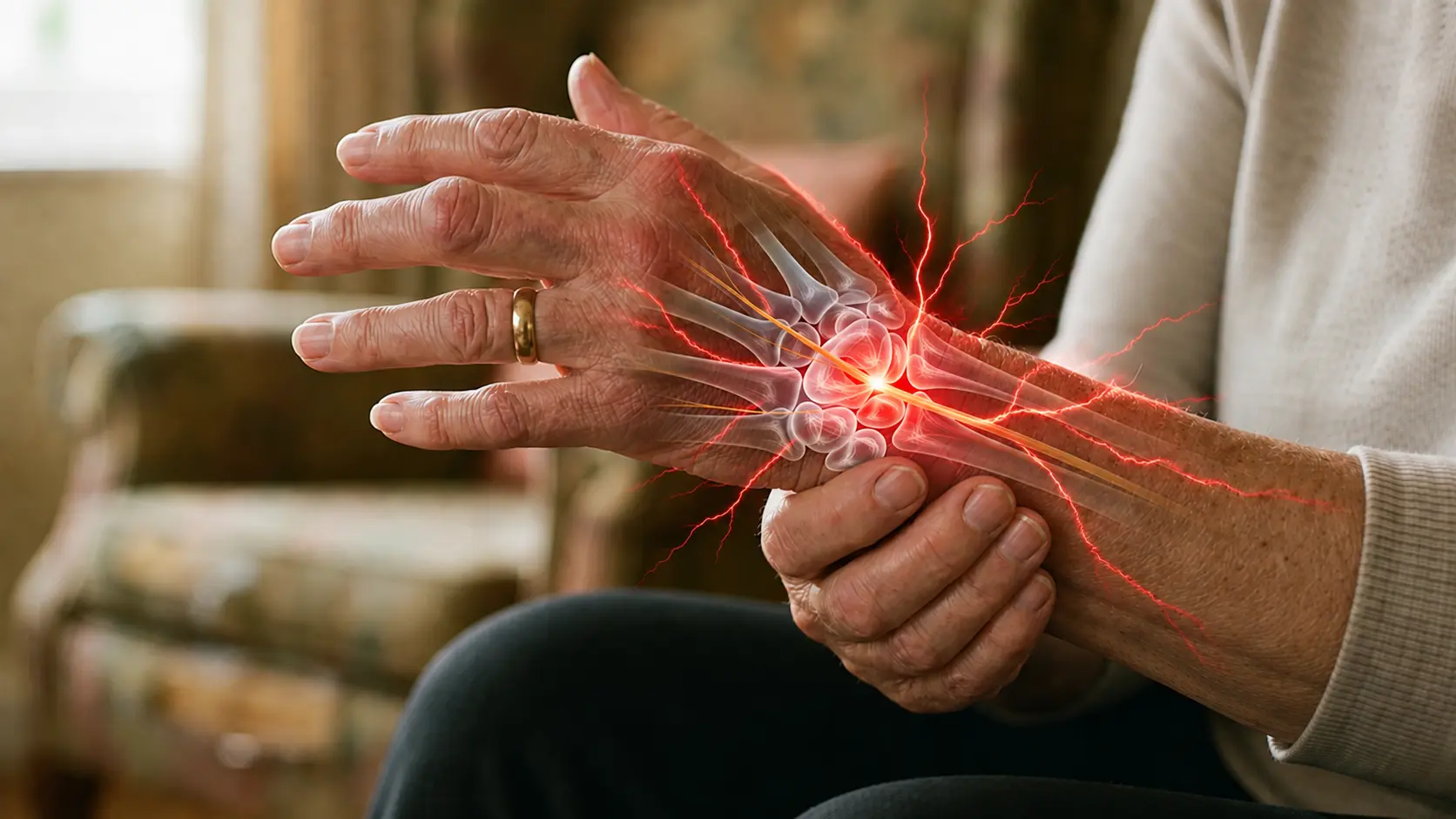

Dear reader, I'm going to describe something, and I need you to be brutally honest with yourself about whether it sounds familiar.
You're lying in bed at 2 AM. Your eyes snap open — not because of a noise, not because of a nightmare — but because your fingers have gone completely numb. Your thumb, your index finger, your middle finger. They feel like they belong to someone else.
You do what you always do. You shake your hand out, flick your wrist, hang your arm off the side of the bed. The tingling fades. You fall back asleep.
Until it happens again two hours later.
During the day, it's different but no less maddening. That pins-and-needles sensation when you hold your phone. The dull ache that creeps from your wrist into your forearm, up into your elbow. The stiffness in your knuckles every single morning — like your fingers have been dipped in concrete overnight.
Maybe it's the swollen joints that scare you most. Your wedding ring doesn't fit anymore. Your knuckles are visibly thicker than they were two years ago. You hide your hands when someone reaches out to shake them because you're afraid of the pain — and the embarrassment.
Or maybe it's the sudden, sharp “electric shock” that shoots through your fingers when you least expect it — while gripping the steering wheel, lifting a grocery bag, or trying to button your shirt.
And here's the thing that probably confuses you most: you can't seem to get a straight answer. One doctor says “arthritis.” Another says “carpal tunnel.” A third says “it's just age, learn to live with it.”
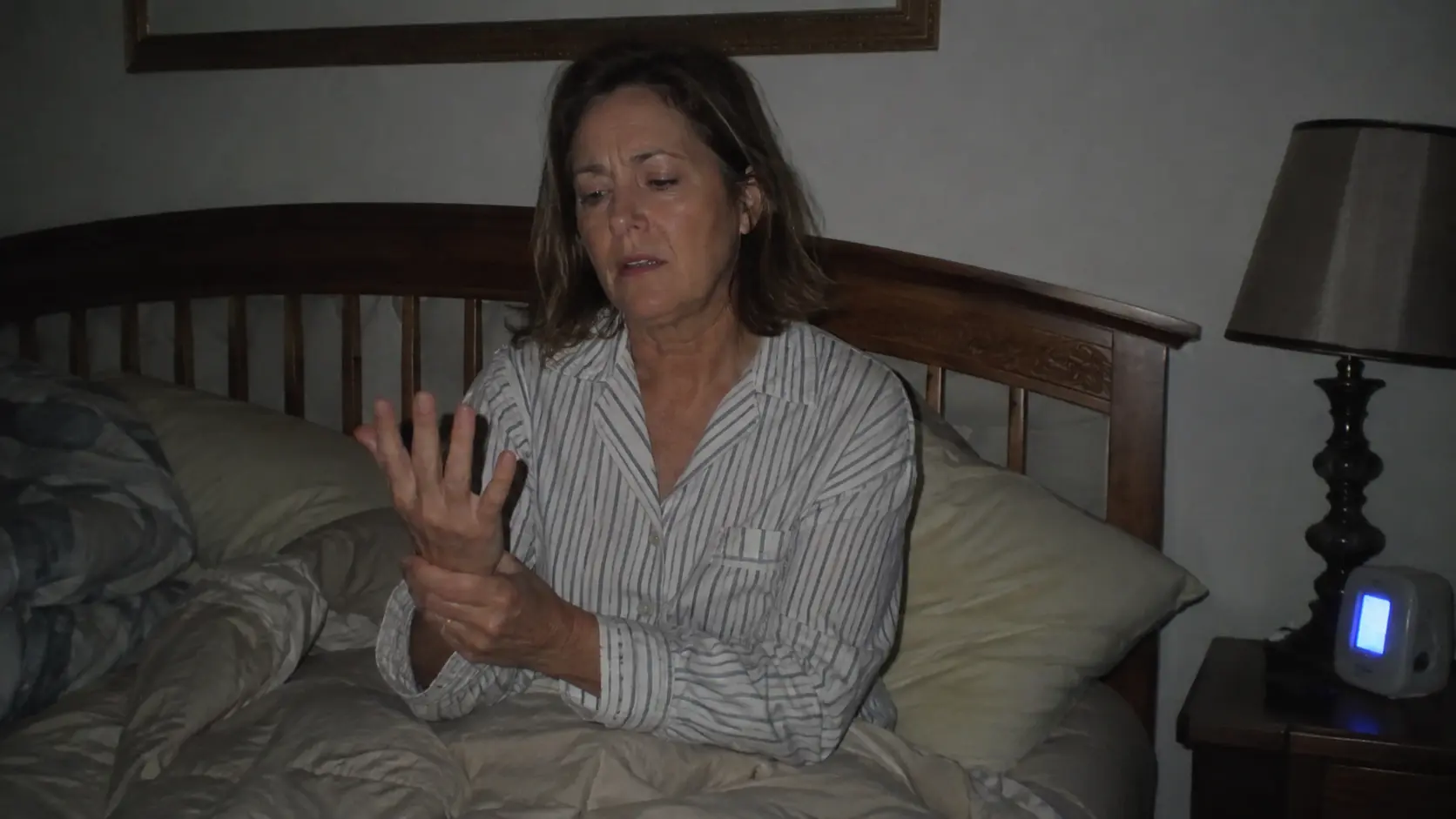
If you just read that and thought “how does this person know exactly what I'm going through?” — keep reading.
My name is Dr. David Reeves. I've spent 22 years as a hand and nerve specialist and examined over 14,000 patients. That tingling, numbness, stiffness and swelling in your hands? Whether it's been called carpal tunnel, arthritis, repetitive strain, tendonitis, or just “getting older” — very often the same thing is sitting underneath it: inflamed tissue pressing on the nerve.
I call it The Tunnel Squeeze. Because that's exactly what's happening — inflamed tissue slowly squeezing your median nerve, millimetre by millimetre, day by day.
The Sunday Everything Changed
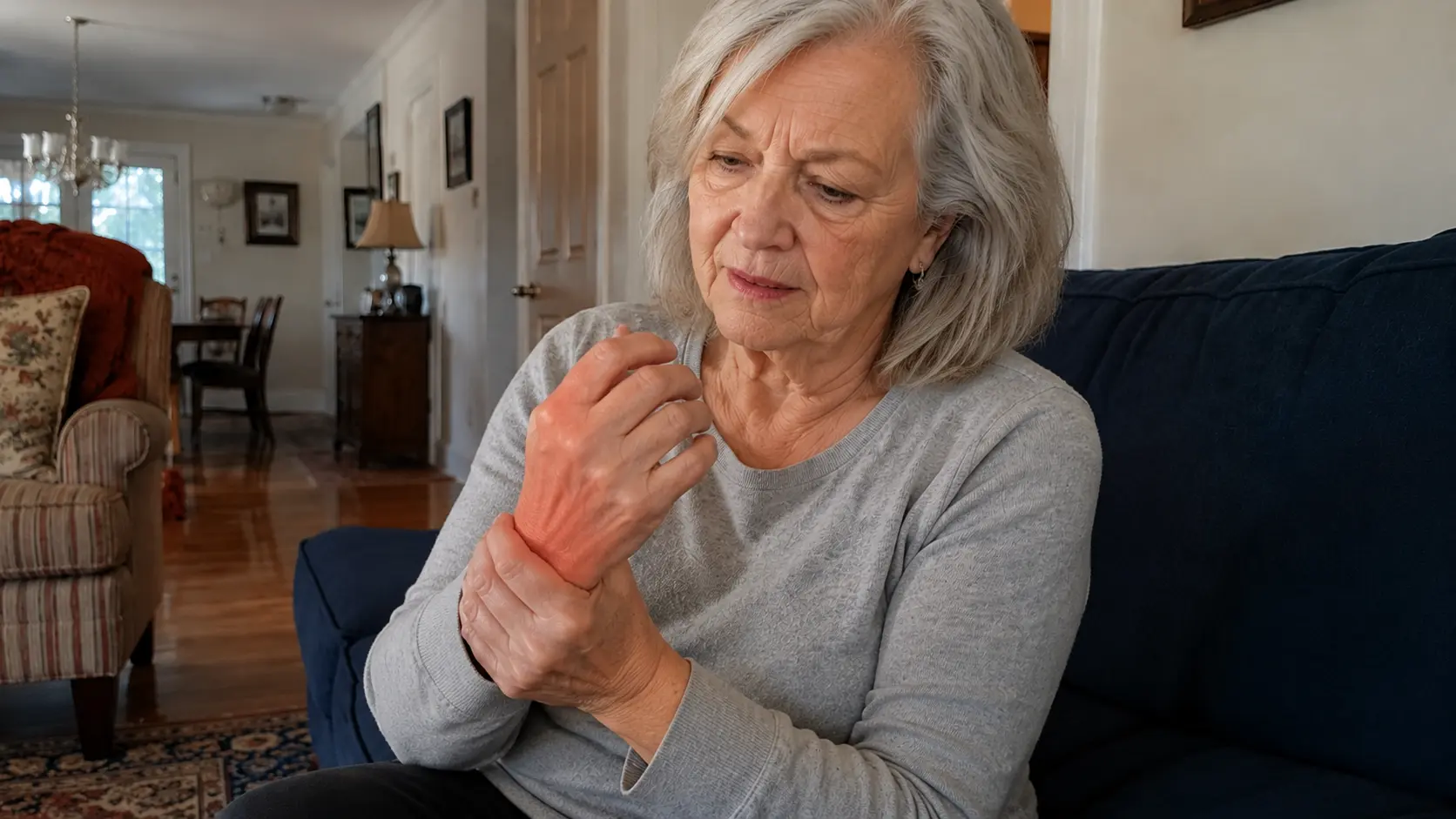
Three years ago, I watched my 74-year-old mother try to carry her granddaughter's birthday cake to the table at a family gathering. She'd baked it herself — chocolate, three layers, her famous recipe. Halfway there, her fingers just… opened.
The cake hit the floor. My niece started crying. My mother stood there looking at her hands like they'd betrayed her.
She had been diagnosed with osteoarthritis in both hands at 66. By 70, she'd also developed carpal tunnel syndrome. Over the next four years she was passed from specialist to specialist. Each one treated their piece. None of them saw the whole picture.
- Rheumatologist: 14 months of arthritis medication. Constant nausea, barely any change in the swelling — and the numbness was “not my department.” About $4,200.
- Pain management: six cortisone injections over two years. Each worked for a few weeks, then the relief window kept shrinking. About $2,100.
- Orthopedist: custom braces, nerve conduction studies, a diagnosis of “moderate carpal tunnel” and a recommendation for surgery. About $3,400.
- Physical therapy, 16 weeks: grip strength up maybe 10%. Numbness and morning stiffness unchanged. About $5,600.
Over $15,300 in two years. And after all of it, she still couldn't hold a birthday cake.
Standing in that kitchen, I made a decision: I was going to look for the thing underneath both of them — not the arthritis, not the carpal tunnel, but what connects them.
The Link Most People Are Never Told About
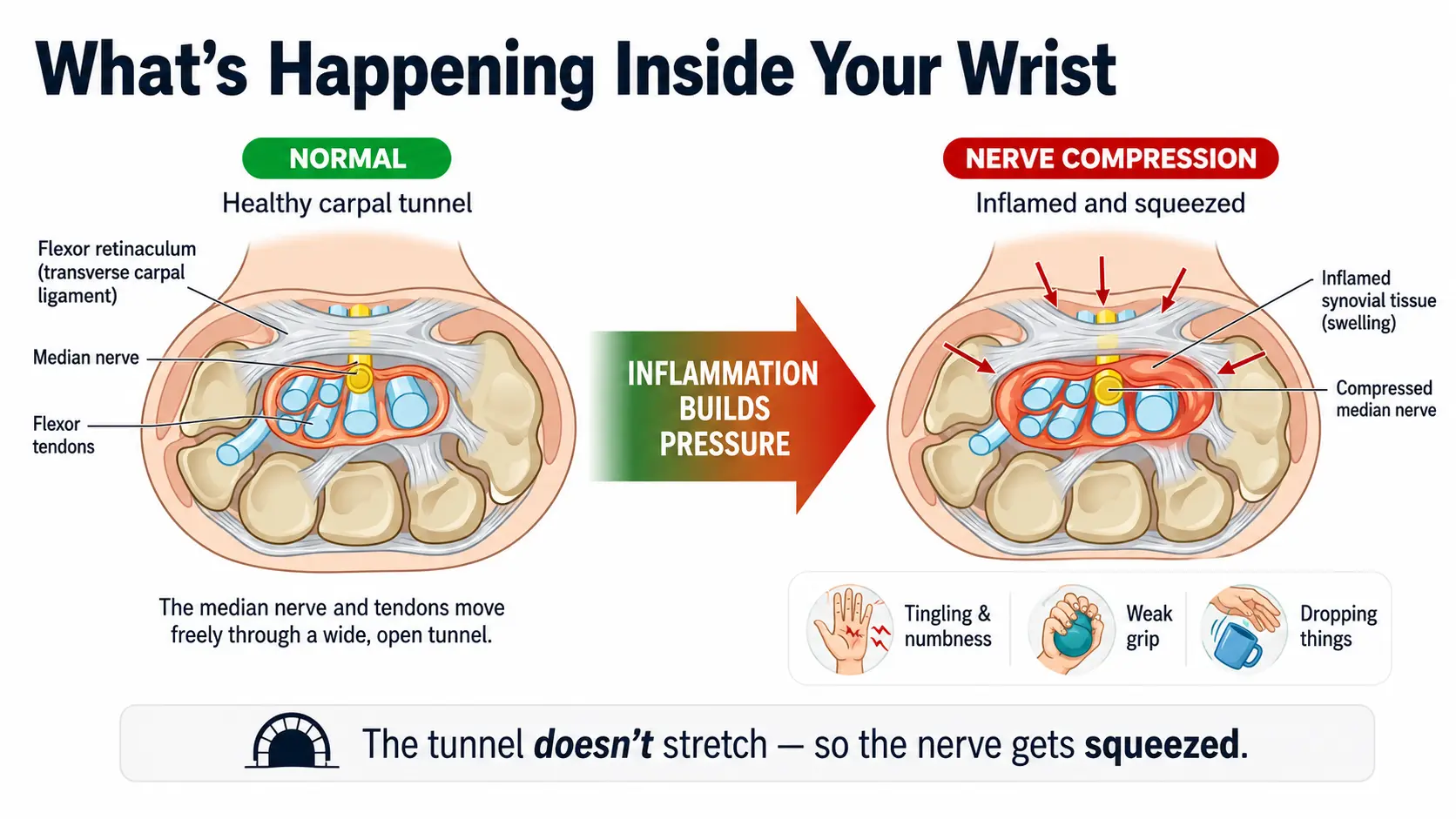
Inside your wrist there's a narrow passageway about the diameter of your index finger called the carpal tunnel. The median nerve — which handles sensation and movement for most of your hand — runs through it alongside nine flexor tendons.
When the tissue around those tendons becomes chronically inflamed — from arthritis, from repetitive use, from ageing, or most often a combination of all three — that passageway starts to shrink, and the nerve gets squeezed.
Inflammation swells the tissue. Swollen tissue compresses the nerve. The compressed nerve causes numbness and weak grip. You compensate, which creates more strain — and more inflammation. Dr. David Reeves
That's The Tunnel Squeeze: a self-reinforcing cycle. And most of the usual treatments address one point on the cycle without breaking the cycle itself. It's also why so many adults with arthritis in their hands end up with carpal tunnel symptoms too.
Why “Wait and See” Rarely Works Out
Here's the progression I've watched unfold in a great many patients:
-
Stage 1
Intermittent tingling, morning stiffness, occasional numbness. Knuckles ache when it's cold. You shake it off and assume it'll get better on its own.
-
Stage 2
Numbness becomes constant. Pain radiates into the forearm. You start dropping things — your phone, your coffee cup, your keys. Jars and buttons become a battle.
-
Stage 3
The muscle at the base of your thumb begins to visibly shrink. This is called thenar atrophy, and it's the stage where lasting nerve damage becomes a real risk.
I'm not telling you this to frighten you. I'm telling you because so many patients have sat in my office and said the exact same thing: “I thought it would just go away.” If your symptoms are getting worse, please get them properly assessed.
Why Everything You've Tried Has Let You Down
Anti-inflammatory tablets. They dull the pain by reducing inflammation across your whole body — but they can't concentrate their effect on the tiny area inside your carpal tunnel. And long-term daily use carries real side-effect risks.
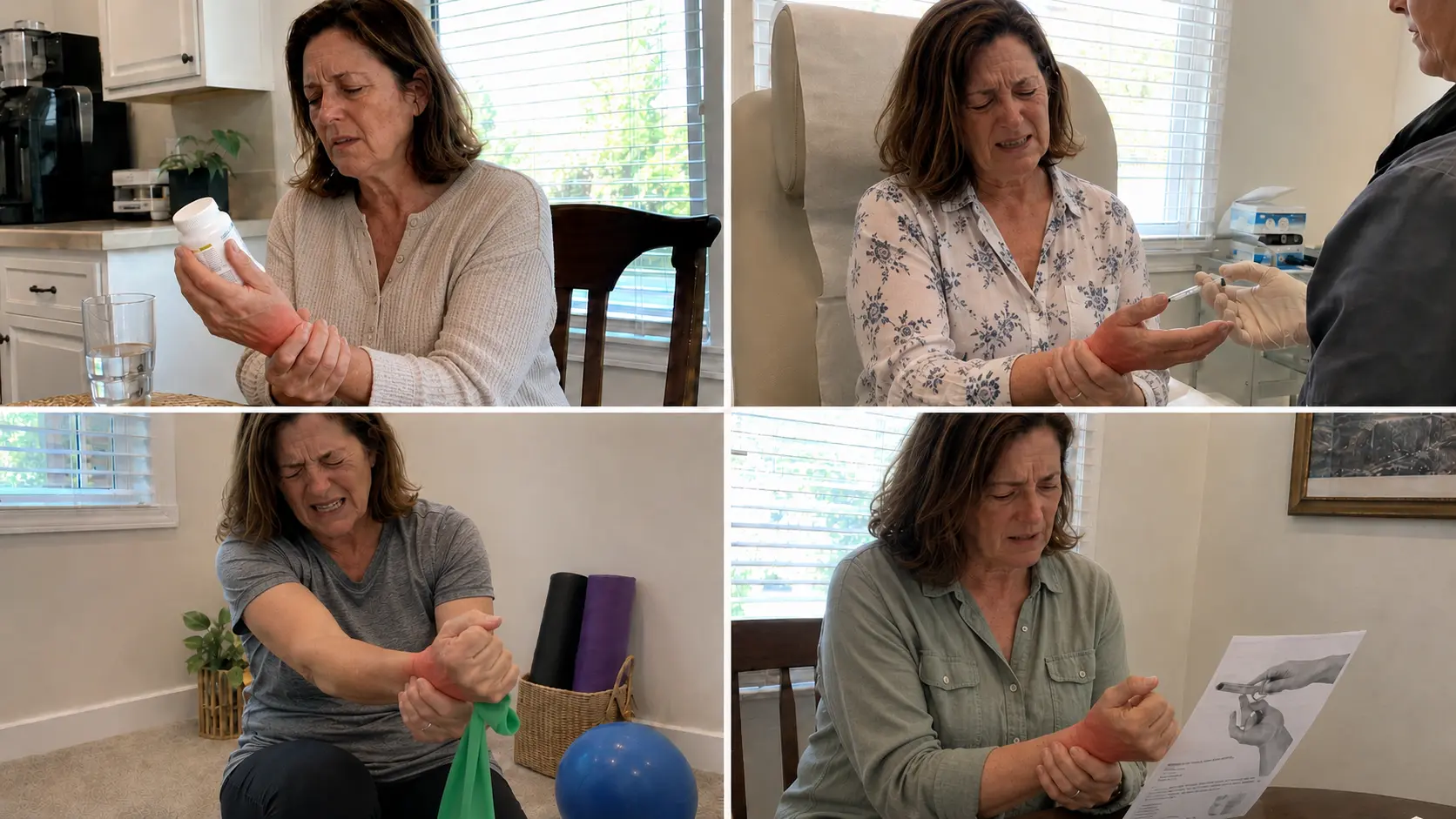
Cortisone injections. Temporary relief, usually 6 to 12 weeks. Then the inflammation tends to come back, and for many people each injection works a little less well. At $300–$500 per shot, it adds up quickly.
Physical therapy. At $150–$200 a session, it's a significant cost. Some patients improve, many plateau after 8–10 weeks. The exercises strengthen the muscles around the problem without reaching the inflamed tissue itself.
Surgery. Carpal tunnel release typically costs $5,000 to $10,000 and needs weeks of recovery. It can be the right choice for many people — but it doesn't touch arthritis, and some patients see symptoms return over time.
So when I found something that works on the inflammation itself, at home, for a fraction of those costs — I wanted my patients to know about it.
The 15-Minute Routine: Red and Near-Infrared Light
After the cake incident, I spent three months reviewing the research on a technology called photobiomodulation — PBM for short.
PBM uses specific wavelengths of red and near-infrared light that penetrate tissue at the cellular level. It isn't a heat lamp and it isn't UV. It has been the subject of thousands of published studies, including research from NASA and work at Boston University School of Medicine on carpal tunnel patients.
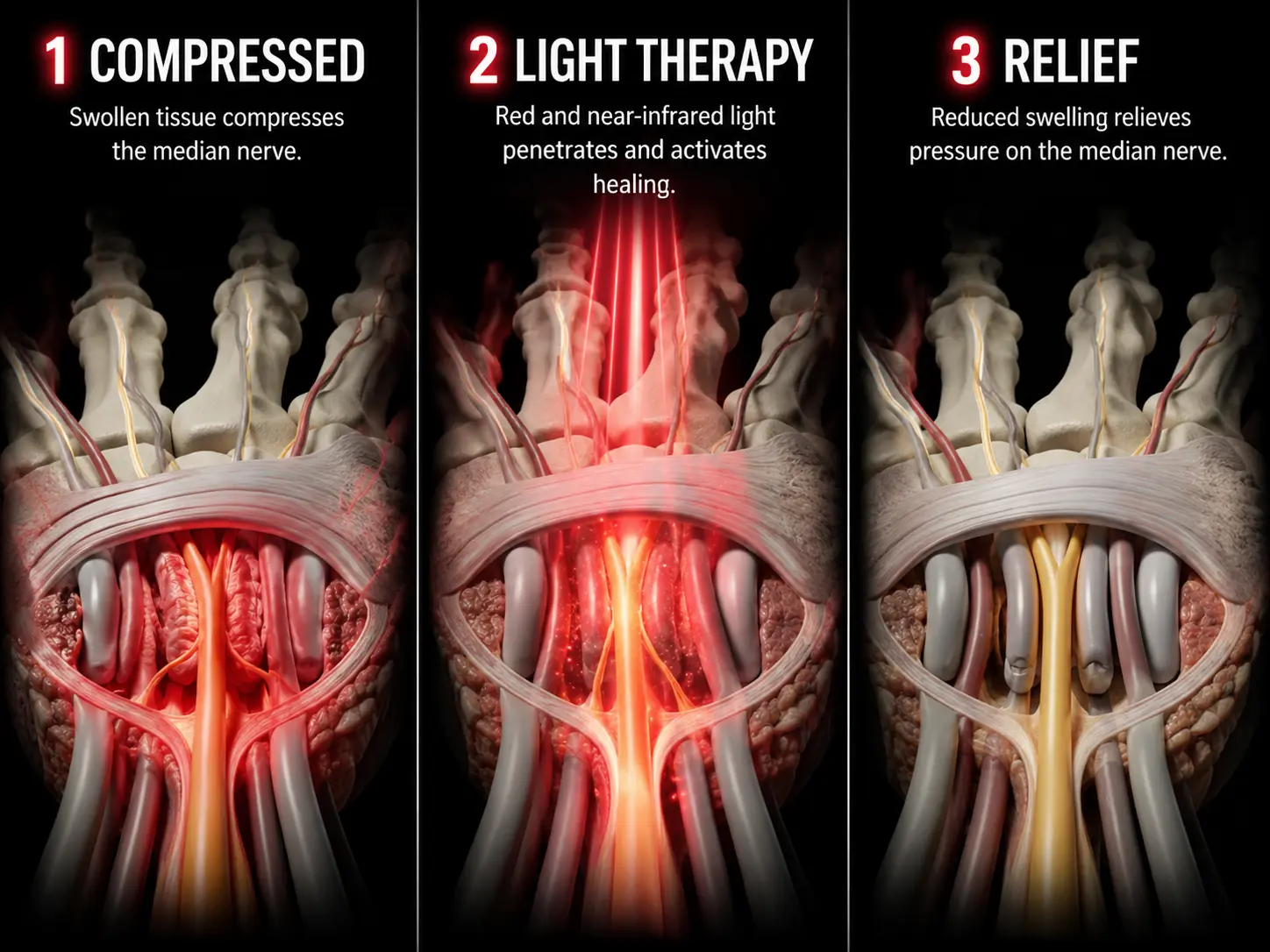
Minutes 0–5: circulation
Red light at 660 nanometres penetrates the skin and encourages blood vessels to open up, bringing fresh, oxygen-rich blood into the area around the carpal tunnel.
Your hand starts to feel warm — not from heat, but from circulation.
Minutes 5–10: cellular energy
Near-infrared light at 850 nanometres reaches deeper, through skin, muscle and connective tissue, where it supports the production of ATP — the energy molecule your cells use for repair.
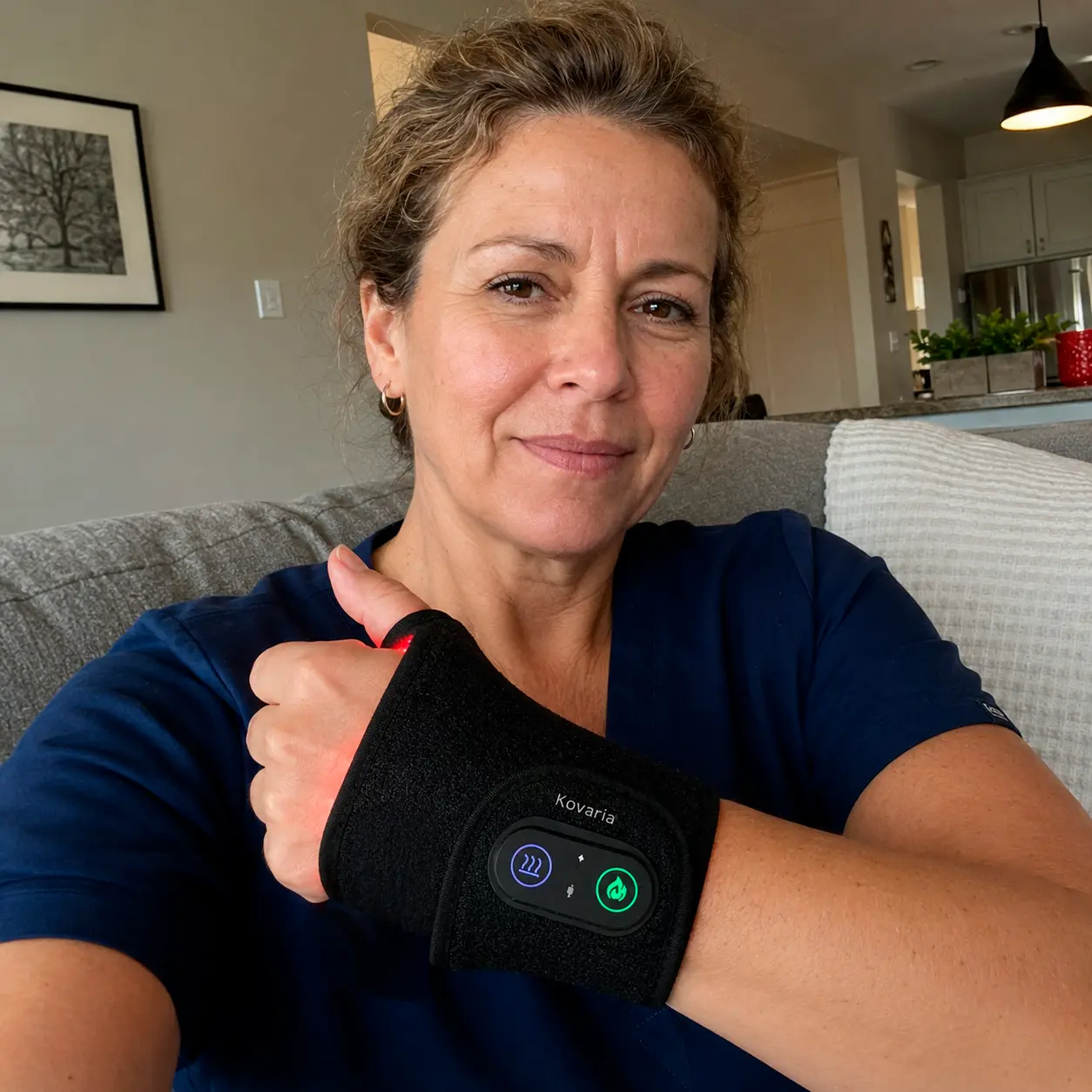
Minutes 10–15: calming inflammation
The combination of both wavelengths is associated in the research with a reduction in pro-inflammatory signalling — the chemistry that keeps tissue swollen and joints aching.
One mechanism, working on the inflammation behind both arthritis and carpal tunnel discomfort.
This is the key difference. The braces, the pills and the injections work around the problem. PBM works on the tissue where the discomfort actually lives.
TheraWrap: The Device I Now Recommend
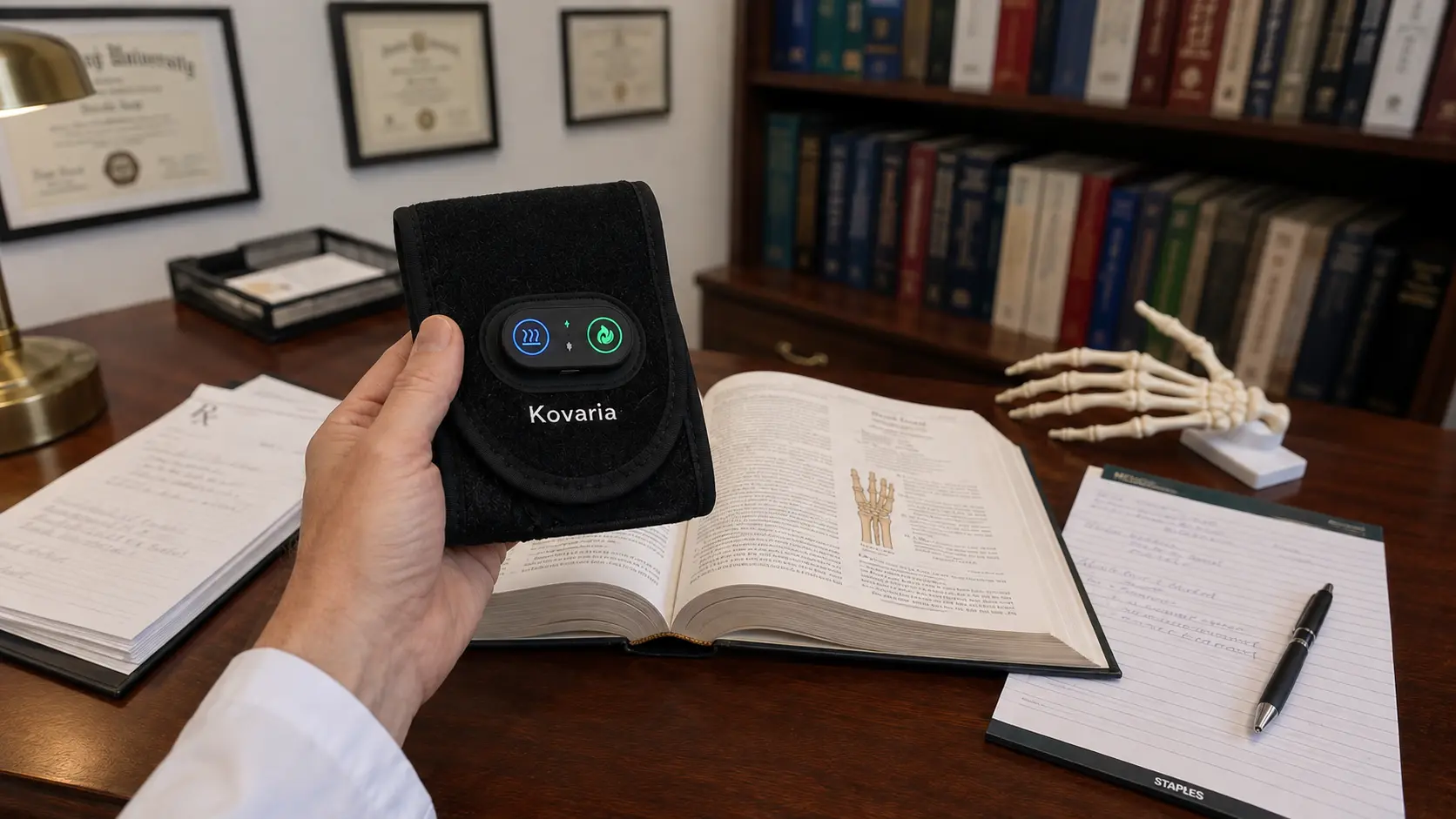
I went looking for a PBM device that met clinical standards but was designed for home use. Most of what I found was cheaply made, used the wrong wavelengths, or didn't have enough LEDs to deliver a meaningful dose. Then I found TheraWrap.
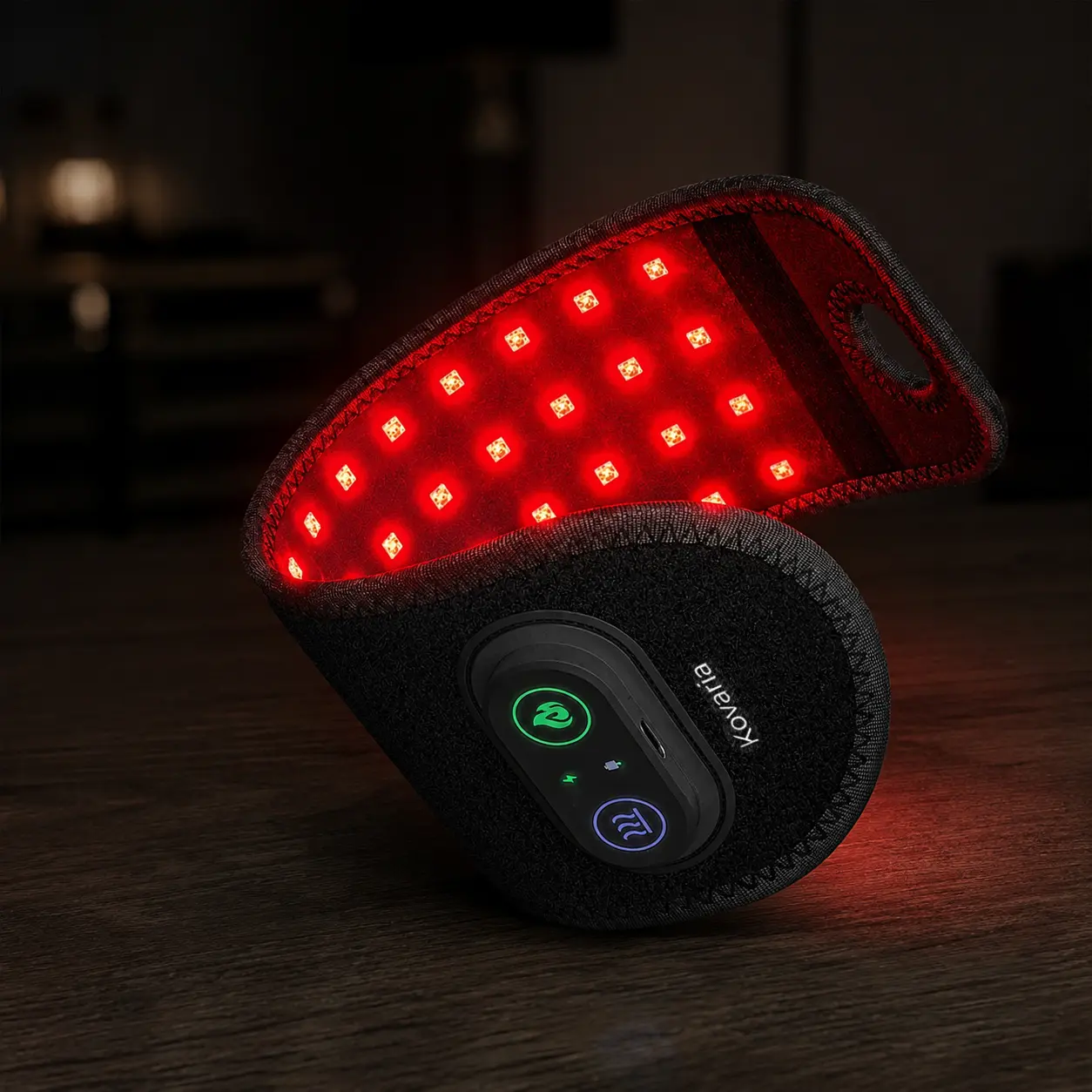
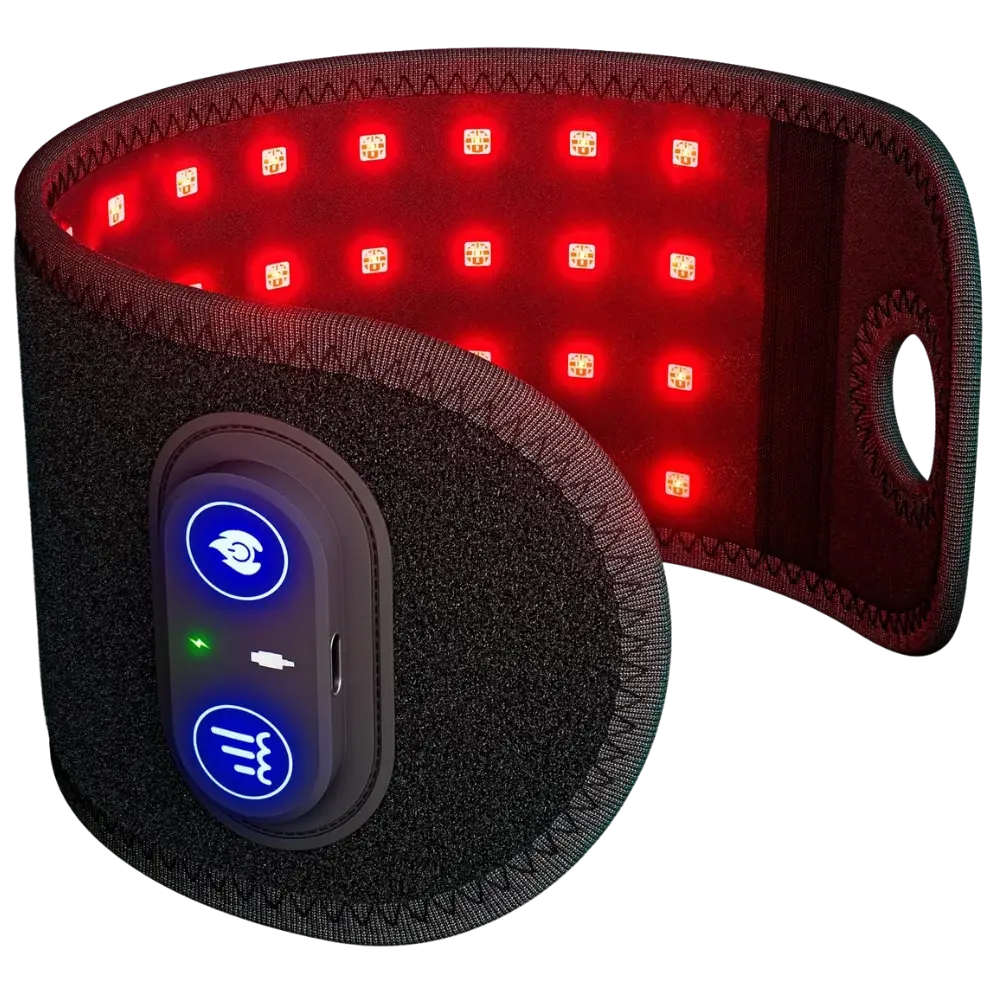
It's a wrist-worn device with 48 LED chips — 24 red (660nm) and 24 near-infrared (850nm) — arranged to deliver both wavelengths at once across the whole carpal tunnel area.
It's made in an FDA-registered facility and has been third-party tested for safety and electromagnetic compliance. It has 3 power levels and 4 therapy modes, it's cordless and rechargeable, and it weighs just 126 grams.
You wrap it around your wrist and press one button. Fifteen minutes later it switches itself off. No pills, no needles, no appointments.
“I told her: Mom, use it for 15 minutes every evening. Don't change anything else. Don't stop your medications. Just add this. She called me on day three — ‘David, I slept through the night. I haven't slept through the night in eleven months.’”
What Happened to My Mother
-
Week one
Her morning stiffness — the kind where she couldn't make a fist until noon — was down by what she estimated was about 60%.
-
Week two
Her daytime numbness had dropped noticeably. She could feel the TV remote in her hand again.
-
Week four
She picked up a jar of pasta sauce at the grocery store and opened it herself. She stood in the aisle and cried.
-
Month three
She baked another chocolate cake. Three layers. She carried it to the table with both hands. This time, she didn't drop it.
I forgot what my hands used to feel like. I forgot they used to hurt. Eleanor, Dr. Reeves' mother
The Patient Who Made Me Go Public

Shortly after, a dental hygienist named Linda sat in my exam room in tears. She was 54. Her right hand had carpal tunnel, her left had early-stage arthritis — and for someone who uses precise hand movements eight hours a day, that was a career on the line.
“I can't feel my instruments anymore,” she told me. “I'm gripping them so hard to compensate that my forearms are cramping by noon.”
She had already tried braces, cortisone injections and four months of physical therapy. I gave her a TheraWrap and told her 15 minutes every evening.
At two weeks her daytime numbness had eased considerably and the forearm cramping had stopped. At three months she was working full days comfortably, with both hands improving from the same device and the same 15 minutes.
What My Patients Report
After recommending TheraWrap to more than 400 patients and tracking what they told me, here's what they reported:
Based on patient-reported outcomes, not an independent clinical trial. Individual results vary.
What to Expect When You Start
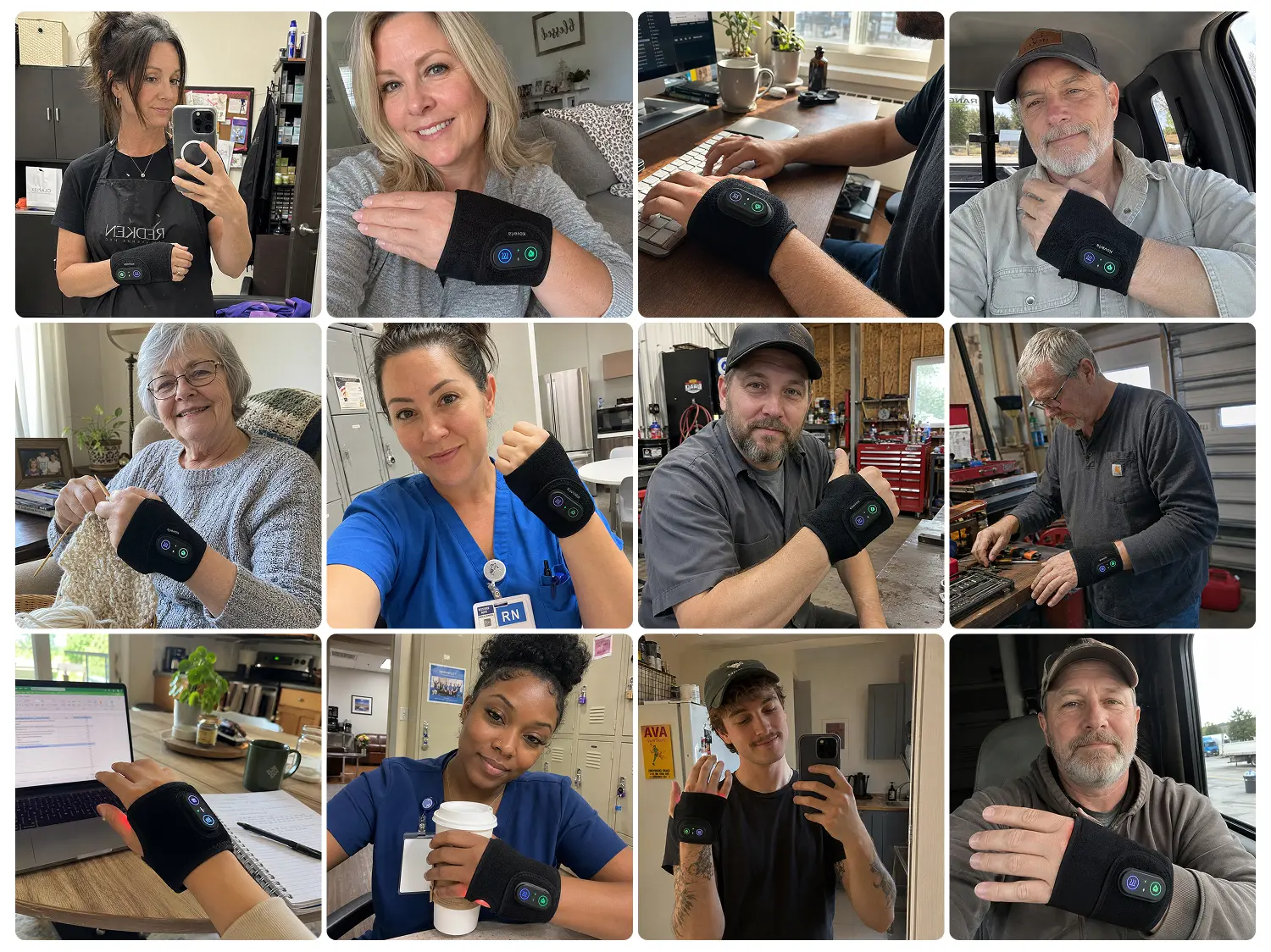
- Days 1–3: first signs of relief
Many users notice less nighttime tingling and better sleep within the first few sessions. Morning stiffness begins to loosen.
- Weeks 1–2: daytime discomfort eases
Daytime numbness eases, grip returns and swelling can visibly settle. You start doing things with your hands you'd given up on.
- Weeks 3–6: life starts coming back
Buttons, jars and pens stop being enemies. Improvement in hand function builds session by session.
- Weeks 8+: long-term hand health
Patients return to hobbies they'd abandoned — guitar, gardening, woodworking.
TheraWrap — 48-LED red & near-infrared wrist therapy, 15 minutes a day
TheraWrap is on a summer sale right now at 50% off, with free shipping and a 90-day money-back guarantee.
 Check Today's Price & Availability
- 90-day money-back guarantee
- Free shipping
- No subscriptions, no recurring costs

I almost didn't try it — I mean, $69 vs. a $7,000 procedure? How could it work? But I was desperate. Within 5 days the nighttime numbness was 80% gone. It's been 4 months now and I'm still using it every evening.
What Others Are Saying

Retired contractor. 40 years of hammers and power tools destroyed my hands — arthritis and carpal tunnel together. My wife had to open jars for me. Six weeks on TheraWrap, both wrists. Yesterday I changed a flat tire by myself.

I'm a pianist. The arthritis took my knuckles first, then the carpal tunnel took my feeling. I stopped playing in January. Started TheraWrap in March. By April I was playing Chopin again, with feeling in every finger.

My doctor told me to ‘learn to live with it.’ At 56. I ordered TheraWrap that same night out of pure spite. Three weeks in, the tingling is almost gone and my joints don't ache in the morning.
My daughter found this for me. Within five days I was sleeping through the night again. Fifteen minutes in front of the TV every evening — that's all it takes.
Let's Talk About What This Actually Costs

- Carpal tunnel surgery: $5,000 – $10,000
- Physical therapy (6 months): $3,600 – $4,800
- Cortisone injections (per year): $600 – $1,200
- TheraWrap, one-time: $69.98 on the summer sale (regularly $139.96)
Both hands bothering you? Most of my patients have symptoms in both wrists. The 2× TheraWrap bundle is $109.98 — you save $30 against buying two separately, and it's the most popular choice for combined arthritis and carpal tunnel.
Free shipping · No subscriptions · No hidden fees · No recurring costs
“Okay, But I've Been Burned Before.”
If this works, why hasn't my doctor told me about it?
Most care is built around office visits, injections, prescriptions and procedures. A device you buy once and use at home simply doesn't come up in that system very often. The research on photobiomodulation is published — it just isn't something most clinics sell.
This seems too cheap to actually work.
LED technology has become remarkably affordable. TheraWrap uses the same 660nm and 850nm wavelengths studied in clinical research. The difference between a professional machine and a well-made home device is mostly the housing and the brand name — not the light itself.
I have arthritis AND carpal tunnel. Will one device help both?
That's where TheraWrap makes the most sense. Because inflammation sits behind both, the same dual-wavelength session works on both at once. You're not treating two problems — you're working on one cycle.
How do I use it?
Wrap it around your wrist, choose one of the 3 power levels and 4 modes, and press the button. It switches itself off after 15 minutes. It's cordless and rechargeable, so you can use it on the sofa, at your desk or in bed.
What if it doesn't work for me?
TheraWrap comes with a 90-day money-back guarantee. Use it every day for three months. If you don't notice a meaningful improvement in your sleep, grip, pain or stiffness, send it back for a refund. Guarantee terms are set by the seller — check them on the product page.
Should I stop my current treatment?
No. TheraWrap is something you add, not a replacement for care from your own doctor. Don't stop or change medication, or cancel a planned procedure, without speaking to the clinician who prescribed it.
You Have Two Paths Forward

Path one: do nothing. The numbness spreads, the stiffness stays, the 2 AM wake-ups continue, and surgery starts to look like the only option left.
Path two: try TheraWrap today. 15 minutes a day at home, dual clinically-studied wavelengths, one device for both arthritis and carpal tunnel discomfort, 50% off at $69.98, and a 90-day money-back guarantee behind it.
I've seen both paths many times. The patients who act early — while it's still Stage 1 or Stage 2 — tend to do much better than the ones who tell themselves “it's not that bad yet.”
Exactly What to Do Right Now
- Click the button below
You'll be taken to TheraWrap's secure checkout page, protected by 256-bit SSL encryption.
- Choose your package
One TheraWrap for one hand, or the 2× bundle if both hands are affected — the most popular option and the best value.
- Feel the difference
Ships free. Many users notice better sleep within 2–3 nights and easing daytime numbness within 1–2 weeks.
90-Day Money-Back Guarantee | Free Shipping
One Last Thing
When I first started recommending TheraWrap, it sold for $139.96. The current price — $69.98 with free shipping — is a summer sale, and I don't know how long it will last.
Try it. Use it for 90 days. If it doesn't make a difference, send it back.
Your hands are worth 15 minutes and $70. You know they are.
P.S. — Try this: press the backs of your hands together with your fingers pointing down and hold it for 30 seconds. If you feel tingling or numbness in your thumb, index or middle finger, that's what's known as a positive Phalen's test — one of the standard checks for carpal tunnel compression. It's worth mentioning to your doctor, and worth looking at TheraWrap while the sale is on.
About the author
Dr. David Reeves has spent 22 years working with hand and nerve problems and has treated more than 14,000 patients. He started recommending TheraWrap after it helped his own mother, Eleanor, get back to doing the things she loved with her hands.
Pricing, bundles and stock are shown on the official product page.
Advertising disclosure: This page is an advertisement published by Product Review 24 Inc. and is not a news article, blog, or consumer protection update. The story and the people depicted are illustrative, based on results some users of this product have reported; the results described may not be the results you achieve. Product Review 24 Inc. may earn a commission when you buy through the links on this page, at no additional cost to you. We are not the manufacturer or seller of the product described; all orders, payments, shipping, returns and customer service are handled by the seller.
Health disclaimer: This product is not intended to diagnose, treat, cure or prevent any disease. It is not medical advice and is not a substitute for treatment prescribed by a physician or other qualified health-care provider. Always consult a qualified healthcare professional before starting any new treatment, and do not stop or change prescribed medication or planned procedures without their advice. Statistics quoted are patient-reported. Individual results vary. Prices, bundle terms, shipping and guarantee conditions are set by the seller and may change without notice — always confirm on the product page before ordering.